

10th March 2026
Share markets are entering a period of high uncertainty once again, this time triggered by the conflict between the United States and Iran.
Markets are already bouncing back after yesterday’s falls.
As usual, keeping emotions calm and staying the course is the best bet for your wealth. Here’s why.
Key points
- Geopolitical conflicts follow a predictable pattern: oil prices spike sharply, share markets fall, then markets recover. This occurred at the start of the Ukraine/Russia war where prices returned to normal shortly after.
- There is strong evidence markets post positive returns in the 12 months after major conflicts, even when headlines imply doom and gloom.
- The US and Trump’s unpredictable policy swings add noise but are not reliable signals for investment decisions.
- Markets stabilise and recover once it’s clear a conflict isn’t triggering a broader financial crisis.
- The real risk is reacting emotionally and missing the rebound, not the volatility itself.
The usual pattern: war starts, oil goes up, shares go down, then back up
Predicting when or why wars break out is not often possible, but the impact on share markets is. The recent conflict between the United States and Iran is triggering waves of unsettling news and sending markets into a panic. But this is a tried and tested pattern.
Wars disrupt the flow of energy resources which is why oil prices surge when a war erupts. Much of the world’s oil supply comes from the middle east, and as such those prices spike as fears their supplies are disrupted push those prices up.
Share markets then react to the energy market, typically declining in those sectors most affected by energy costs: think travel, airlines, shipping, logistics. This spreads over the whole market in a contagion as investors start to panic.
What has always happened in the period following these falls are recoveries in share markets that can often occur quickly. Therefore, the risk for share investors isn’t the war itself or the share market drop, it is reacting emotionally and selling off for a loss and not taking part in the recovery.
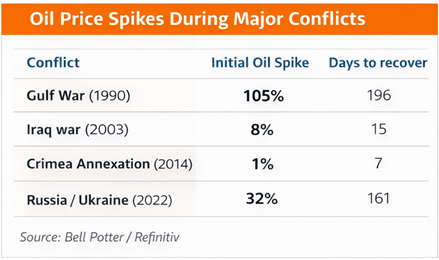
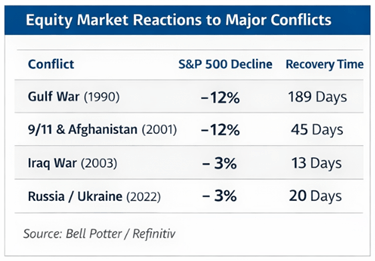
Source: Livewire / Bell Potter / Refinitiv
This pattern is nothing new and we can see it over history time and time again, not only in recent conflicts but also in the largest conflicts of the 20th century.
Strong evidence that wars trigger only short-term downturns in share markets
Geopolitical conflicts always start as a negative for share markets in the short term, but almost in contradiction, share markets have almost always had positive one-year returns in the period following a geopolitical conflict.
This was true for even the largest conflicts in human history: World Wars I & II, the Gulf War, the Iraq War and so on. See a full list of large conflicts and crises and their subsequent impacts on the US share market both in reaction and in 12 months after. Our own market follows closely to what happens in the US, so paying attention there is key wherever you are in the world.
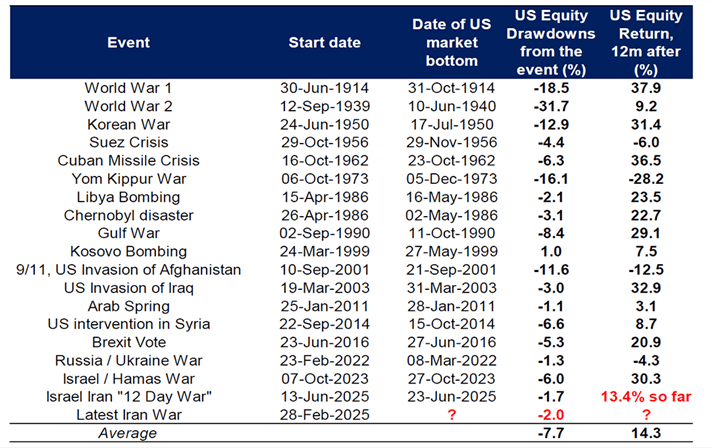
Source: Bloomberg, AMP
Behaviour and reaction hurt more than share market volatility
History has always taught us that trying to anticipate geopolitical impacts on investments is a losing game.
Markets move faster than investors can react. Oil goes up 15% in a week and shares lost 6% in the same week. Trying to react by selling off in anticipation will usually mean not selling off in time or buying in time for the eventual recovery.
Even professionals don’t consistently get it right in reaction. Morningstar conducted research into ‘tactical’ asset allocation over a 20-year period, which is where professional investment asset managers tactically react to conditions and change their portfolios frequently to attempt to capitalise on these short-term swings.
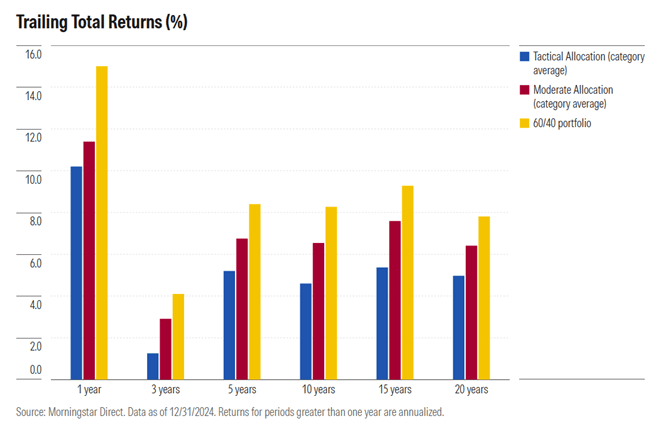
Source: Morningstar
The blue bar above shows the group of ‘tactical’ asset managers and their average returns. The yellow bar represents a ‘static’ asset allocation of a 60/40 portfolio, which is a portfolio of 60% shares and 40% bonds, that is never changed over time. The red bar represents asset managers that sit as a hybrid between these two styles.
Over time and over every period, it is proven that not reacting to market sentiment and the noise of the short term far outperforms trying to adjust your portfolio in reaction to what is happening.
Therefore, as with almost every occurrence of market volatility, the best thing to do is nothing, wait out the volatility and receive your dividends.
As your advisers, we have seen times like this come and go time and time again. It is our job to help you make decisions to prolong your wealth and for you to prosper.
As such we remind you to stay the course and speak with us if what is happening is making you nervous. We are always here to help.
General Advice Warning: This provides general information and hasn’t taken your circumstances into account. It’s important to consider your particular circumstances before deciding what’s right for you. Although the information is from sources considered reliable, Mandate Financial Planning and Futuro Financial Services Pty Ltd do not guarantee that it is accurate or complete. You should not rely upon it and should seek qualified advice before making any investment decision. Except where liability under any statute cannot be excluded, Mandate and Futuro do not accept any liability (whether under contract, tort or otherwise) for any resulting loss or damage of the reader or any other person.
